The correct poly mailer size depends on your product’s folded width, folded length, and packed thickness — not the dimensions of the item laid flat. Pack the product exactly as it will ship, measure the finished bundle, then select a mailer with enough room to insert the item easily and close the seal without tension. A mailer that is technically large enough on paper can still slow down fulfillment if it leaves no working room, and an oversized one wastes material and looks careless on arrival.
Common Poly Mailer Sizes and What They’re Used For
Poly mailers are commonly sold in the size range below. Each is listed with the product types it is generally associated with.
6 × 9 in
Often used for small, flat, low-bulk items such as socks, underwear, or small accessories. Tolerance for thickness is limited, so compact but bulky items frequently need the next size up.
9 × 12 in
A common choice for single lightweight garments — children’s clothing, lightweight tops, scarves, or a single thin T-shirt. This size works best when the folded item genuinely lies flat.
10 × 13 in
One of the most widely stocked sizes for apparel shipping. Frequently considered for folded adult T-shirts, shirts, and leggings, and sometimes for small two-item orders depending on fabric bulk.
12 × 15.5 in
Often used for medium-bulk apparel such as jeans, pants, and lighter sweatshirts. With products in this category, thickness usually matters more than the folded footprint.
14.5 × 19 in
A common reference point for bulky apparel including hoodies, sweaters, and jackets, as well as multi-garment orders. Folding method has a significant effect on what actually fits.
19 × 24 in
Typically used for large or high-volume goods — coats, bedding, blankets, pillows, and larger multi-item orders. Compressible products sometimes fit more easily than their measured thickness would suggest.
These are general starting points, not guaranteed fit recommendations. What you actually need will shift based on:
- Product thickness after folding
- Folding and bundling method used in your warehouse
- Number of items per shipment
- How each supplier measures and labels its mailers
How Poly Mailer Dimensions Actually Work
Width and Length
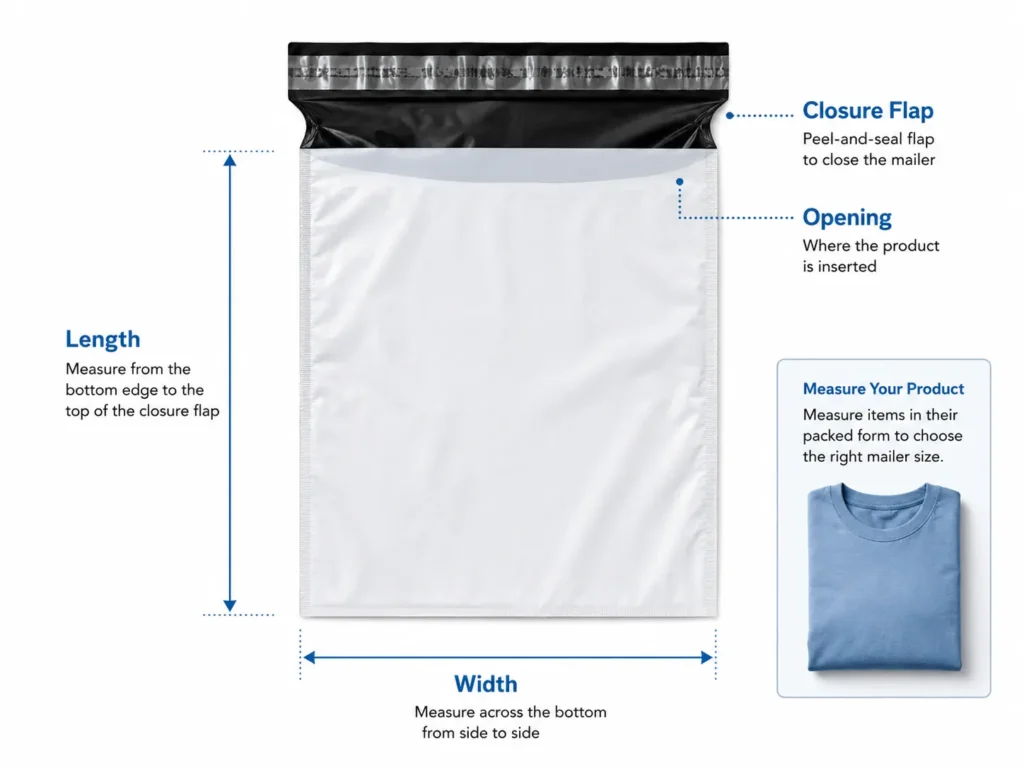
Poly mailers are normally listed as Width × Length, in inches. Width is the measurement across the opening; length runs from the opening down to the sealed bottom. A “10 × 13” mailer is 10 inches wide and 13 inches long.
Flat Size Is Not the Same as Filled Capacity
This is where most sizing errors begin. A poly mailer is measured flat, as a two-dimensional shape. Your product is not flat.
Once an item with real thickness goes inside, the film has to wrap around that depth. Folds, stacked layers, and corners all consume space that the flat measurement never accounted for. The thicker the product, the more of the mailer’s nominal width and length gets used up in simply going around it.
There is no universal conversion rule here, and you should be skeptical of any source offering one. How much capacity a given thickness consumes depends on the material’s flexibility, how the product is folded, and how much the contents compress. The practical approach is to test with the actual packed product rather than calculate from a formula.
Does the Mailer Size Include the Closure Flap?
Suppliers do not all measure the same way, and identical size labels can describe different usable capacity.
Before ordering in volume, confirm three things with your supplier:
- Whether the stated length includes the closure flap or stops at the seal line
- Whether the listed figures are exterior dimensions or usable interior dimensions
- Whether the mailer has a gusset, which changes effective capacity
Two suppliers can both list a mailer as 10 × 13 in and deliver noticeably different usable space. If you are switching suppliers or comparing quotes, this is worth asking about directly rather than assuming equivalence.
How to Measure Your Product for a Poly Mailer
Step 1 — Pack the Product the Way It Will Actually Ship
Fold, stack, and bundle the item exactly as your fulfillment team does it. If garments get folded in thirds, fold them in thirds. If orders include a tissue wrap or a card, include those.
Measuring an unfolded garment tells you almost nothing useful about what mailer it needs.
Step 2 — Measure Width, Length, and Thickness
Take all three measurements of the finished bundle. Record them in both inches and centimeters if you work with overseas suppliers — it removes a common source of miscommunication during quoting.
Keep these figures with your SKU records. They become the baseline for every future packaging decision.
Step 3 — Consider Product Thickness
Thickness is easy to overlook because it doesn’t appear in a flat measurement. Hoodies, jeans, knitwear, and multi-item orders all build depth quickly, even when their folded footprint looks similar to a thin T-shirt.
Two products can have nearly identical folded width and length and still require different mailer sizes purely because of how much depth they carry.
Step 4 — Leave Enough Room for Packing and Sealing
A mailer that technically fits is not always the right operational fit.
A size that requires forcing the product in may work fine for one order and become a real problem across hundreds. Consider:
- How easily a packer can insert the product without wrestling it
- Whether packing speed holds up during peak volume
- Whether the flap closes and seals cleanly without tension along the seam
- Whether excess empty space is creating a loose, wrinkled appearance on delivery
The goal is a mailer that a packer can load quickly and seal properly, with modest working room and no significant slack.
What Size Poly Mailer Do I Need?
What Size Poly Mailer for a T-Shirt?
A 10 × 13 in mailer is a common starting point for a single folded adult T-shirt. It is not a guaranteed fit.
Fabric weight, folding method, and garment size all change the result. A heavyweight cotton tee in size 3XL folded in half behaves very differently from a lightweight tee in size S folded in thirds. Measure your own packed product before committing to a bulk order.
What Size Poly Mailer for Two T-Shirts?
Do not simply double the size used for one shirt. Stack both shirts the way they will actually ship, then measure the complete bundle as a single unit.
Two shirts usually add far more thickness than width or length. The size you need may be only slightly larger in footprint but noticeably more demanding in depth.
What Size Poly Mailer for Jeans?
A 12 × 15.5 in mailer is one common reference point for a single pair of folded jeans.
Denim is thick, and the way it is folded changes the outcome significantly. Jeans folded in half stack differently than jeans rolled or folded in thirds. Heavier raw denim takes more space than a lightweight stretch fabric in the same nominal size.
What Size Poly Mailer for a Hoodie?
Hoodies need more room than their folded footprint suggests, and there is no single size that covers all of them.
The hood itself adds bulk that does not compress evenly, and heavyweight fleece builds depth quickly. Garment size matters more here than with thin apparel — the gap between a small and a 2XL hoodie is substantial. Measure the specific styles you sell rather than working from a general apparel assumption.
What Size Poly Mailer for Jackets?
Jacket sizing varies too widely for a single recommendation. A lightweight windbreaker and an insulated winter coat may share a garment size label while requiring completely different packaging.
Do not select mailer size from S/M/L/XL alone. Measure the jacket folded and packed as it ships, and expect your heaviest outerwear styles to drive the size decision.
What Size Poly Mailer for Multiple Items?
Measure the complete packed bundle, not each item separately.
Individual item measurements do not add up predictably once products are stacked. Layers compress against each other, and total depth rarely equals the sum of the parts. If your typical order contains two or three items, measure a real representative order rather than estimating from single-unit figures.
Why Product Thickness Matters
Thickness determines how much of a mailer’s flat width and length actually remains available once the product is inside. Two items with nearly identical folded footprints can require different mailers if one carries significantly more depth.
Depth also behaves unevenly. Collars, hoods, seams, and stacked layers create high points that don’t compress uniformly, and it’s the thickest part of the bundle — not the average — that decides whether a size works.
Dense materials matter more than bulky-looking ones. Denim compresses very little, while a loosely folded lightweight garment may flatten considerably under the seal.
The practical rule: record thickness alongside width and length for every SKU, and size against your bulkiest variant within a product group rather than a mid-range example.
6 Common Poly Mailer Sizing Mistakes
1. Measuring the Item Before Folding
An unfolded garment measurement has almost no relationship to the mailer size you need. Products ship folded, and the folded footprint is what matters.
Sizing from flat garment specs points toward a mailer larger than the packed product actually requires. Measure only after the product is folded and bundled in its real shipping state.
2. Ignoring Product Thickness
Thickness quietly consumes the width and length you thought you had. A mailer chosen purely on two-dimensional fit can turn out to be too tight once the product’s depth is accounted for.
This is most relevant for hoodies, denim, and bundled orders. Record thickness alongside width and length for every SKU.
3. Assuming Every Supplier Measures Mailers the Same Way
Differences in how flap length, exterior dimensions, usable dimensions, and gussets are reported mean that identical size labels do not guarantee identical capacity.
If you change suppliers using only the size number from your previous order, you may receive mailers that no longer fit your product. Confirm the measurement method in writing before placing a bulk order.
4. Choosing the Smallest Size That Technically Fits
A product that just barely goes in is a problem at scale. Tight mailers slow packers down, increase the chance of a poor seal, and produce a stretched, strained appearance on delivery.
Sizing decisions should account for how the mailer performs across hundreds of orders, not whether a single unit can be forced inside.
5. Using One Oversized Mailer for Every SKU
Standardizing on one large size simplifies inventory, and for some catalogs that tradeoff is reasonable. But applying it across a mixed catalog means small items ship in loose, billowing packaging.
The practical downsides are more packaging material than needed, weaker presentation, and unnecessary package volume. Weigh the inventory simplicity against the fit quality your products actually require.
6. Ordering Custom Printed Mailers Before Confirming the Size
Custom printing commits you to a size at scale. Discovering a fit problem after a bulk run has been produced is an expensive correction.
The sequence that avoids this is straightforward: confirm the size with your actual packed product, then finalize artwork for that size, then move into bulk production.
Should You Use One Poly Mailer Size or Several?
When One Size Can Work
A single size may be sufficient when:
- Your SKUs have closely comparable folded dimensions
- Most products are thin, flexible apparel
- Order composition is consistent, with little variation in item count
- Your fulfillment process is simple and you want to minimize SKU complexity
For a focused catalog — a brand selling only T-shirts, for example — one size can be a reasonable operational decision.
When Multiple Sizes Make More Sense
If you sell T-shirts, jeans, hoodies, and jackets, covering everything with one oversized mailer is unlikely to be the best answer.
Stocking two or three sizes can help you:
- Match packaging more closely to what each product actually needs
- Reduce packaging material used on smaller orders
- Deliver a tidier, more intentional presentation
- Keep fulfillment consistent as your product mix expands
Build Simple Mailer Groups
You don’t need a complex system. Sorting SKUs into three broad groups is enough to structure the decision.
Small group — thin, low-bulk items and lightweight single garments.
Medium group — standard folded apparel and medium-bulk items such as jeans or light sweatshirts.
Large group — bulky products like hoodies, jackets, and multi-item orders.
As a rough sorting logic: thin T-shirts tend to fall into the small or medium group, jeans into the medium group, hoodies into the medium or large group, and jackets into the large group.
This is a method for organizing procurement, not a fixed size recommendation. Your own measurements determine which mailer each group actually uses.
Poly Mailer Size Selection Checklist
Before placing a bulk order, confirm:
- Product folded width: ______
- Product folded length: ______
- Product packed thickness: ______
- Items per shipment: ______
- Product is compressible: Yes / No
- Supplier dimensions include flap: Yes / No / Confirm
- Candidate mailer size: ______
- Sample fit confirmed: Yes / No
- Seal closes without tension: Yes / No
- Excess unused space acceptable: Yes / No
If several of these lines are still blank, it’s worth resolving them before committing to volume — particularly the supplier measurement method and the sample fit check.
When Should You Request a Sample?
Confirming fit with a physical sample is worth the extra step in these situations:
- Thick apparel such as hoodies, denim, or outerwear
- Orders that regularly contain multiple products
- Products with irregular shapes that don’t fold into a clean rectangle
- Deciding between two adjacent sizes where the choice isn’t obvious
- Any first custom printed bulk order
For hard, rigid, or fragile products, a standard poly mailer may not be the right format at all — those typically call for custom bubble mailers or another cushioned option. If you’re weighing material choices more broadly, custom paper mailers are worth reviewing alongside poly.
If you’re planning a custom poly mailer order, confirm the size against your packed product before finalizing artwork and production quantity. Getting the sequence right — size first, then artwork, then bulk production — prevents the most costly correction in the process.
Poly Mailer Size FAQ
What is the most common poly mailer size?
There isn’t a single universal answer. The 10 × 13 in size is widely stocked and commonly used for apparel shipping, which makes it a frequent starting point. The right choice still depends on your packed product dimensions rather than on what’s most popular overall.
What size poly mailer should I use for a T-shirt?
A 10 × 13 in mailer is a common starting point for a single folded adult T-shirt, but not a guaranteed fit. Fabric weight, garment size, and folding method all affect the outcome. Measure a folded shirt from your own inventory before ordering in volume.
What size poly mailer should I use for a hoodie?
Hoodies require more space than their folded footprint suggests, because the hood and heavier fabric both add depth. There is no size that works across all hoodie styles and sizes. Measure your specific styles packed as they ship, and size for your bulkiest variant.
Can two shirts fit in one poly mailer?
Often yes, but confirm it with the actual bundle rather than assuming. Stack both shirts the way your team packs them, then measure the combined width, length, and thickness. The added depth is usually the limiting factor.
Should a poly mailer fit tightly?
No. A mailer tight enough to require forcing the product in creates packing delays and increases the risk of a poor seal. Choose a size that allows easy insertion and clean sealing without visible strain, while avoiding significant empty space.
Are poly mailer dimensions inside or outside dimensions?
It varies by supplier, which is why this needs confirming. Before a bulk order, ask whether the stated figures are exterior or usable dimensions, whether the closure flap is included in the length, and whether the mailer has a gusset.