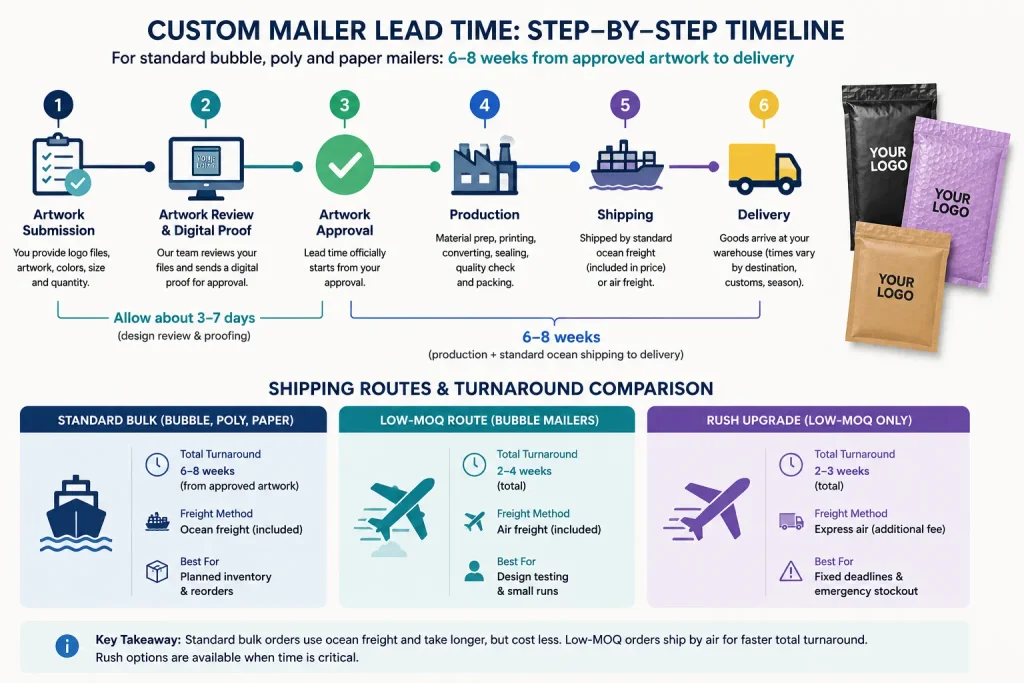
For standard custom bubble, poly and paper mailers, plan on roughly 6–8 weeks from approved artwork to delivery using standard ocean shipping. Artwork review and proofing happen before that window — allow a few extra days at the start, more if your proof needs revisions.
Low-MOQ bubble mailers run on a different production and shipping route, with a shorter published turnaround.
The number most buyers get wrong is not the six-to-eight weeks. It is where the clock starts.
What “Lead Time” Actually Means
Three different numbers get called “lead time,” and suppliers do not all use the term the same way.
Production Time
How long the factory takes to manufacture your order once artwork is approved and specifications are confirmed.
Production time is not delivery time. An order that finishes production is still sitting at the factory.
Shipping Time
How long the finished goods take to move from the factory to your destination.
Ocean freight is slower than air freight and priced differently. For bulk mailer orders, ocean freight can account for a substantial share of the total timeline, which is why production time alone does not tell you when stock will arrive.
Total Turnaround
What you actually care about: the date the pallets reach your warehouse.
Realistically that spans:
Artwork preparation → proofing and approval → production → shipping → delivery
When you request a quote, ask directly: when does your quoted lead time start? Some suppliers quote production only. Some quote production plus freight. Some start counting at payment, others at artwork approval. Two suppliers quoting “four weeks” can mean completely different delivery dates.
On ZaroMailer’s standard mailer range, the published 6–8 weeks runs from approved artwork to delivery, and includes standard ocean freight — production and shipping together, not production alone.
The Custom Mailer Timeline, Step by Step
Step 1: Artwork Submission
You supply logo files, artwork, colors, size and quantity.
This is where timelines quietly slip. If artwork is incomplete, sizing is unconfirmed, or the quantity is still being debated internally, nothing downstream can start. The order exists, but the clock has not begun.
Step 2: Artwork Review and Digital Proof
The supplier reviews your files technically — resolution, color, bleed, placement against the mailer’s print area — and prepares a digital proof for you to check.
ZaroMailer’s bubble and poly mailer pages recommend allowing roughly 3–7 days at the start for design review and proofing. Treat that as a planning allowance, not a fixed step: a clean, print-ready file moves faster, and a file needing rework takes longer.
Step 3: Artwork Approval
This is the checkpoint that matters.
For standard mailers, the 6–8 week window is measured from your approval, not from when you placed the order or paid. Every day a proof sits in someone’s inbox awaiting sign-off is a day added to your delivery date — and it is one of the most common avoidable delays in custom packaging.
If approval needs to route through a brand manager, a founder, or an agency, build that into your plan.
Step 4: Production
Once approved, the order enters manufacturing: material preparation, printing, converting, sealing, quality checks and packing.
Lead times published for bulk custom mailers cover this stage plus freight — the two are quoted together because separating them is not useful to the buyer.
Step 5: Shipping
For standard bulk orders, ZaroMailer ships by ocean freight, included in the quoted price. Rush air freight is available at additional cost.
The low-MOQ bubble mailer route works differently: it ships by standard air freight as part of its normal turnaround, which is a large part of why its published timeline is shorter.
Step 6: Delivery
Final transit to your address.
Actual arrival can be affected by destination, carrier scheduling, customs clearance, seasonal port congestion and weather. These are real variables in any international freight timeline, and no supplier controls all of them — which is the practical argument for not planning to the last available day.
Standard Custom Mailer Lead Times
All three standard mailer lines currently publish the same turnaround:
- Custom bubble mailers — approximately 6–8 weeks from approved artwork to delivery, standard ocean shipping included.
- Custom poly mailers — the same 6–8 week standard route.
- Custom paper mailers — standard production and shipping typically 6–8 weeks.
Two things worth holding onto.
This is a turnaround figure, not a production figure. It already contains ocean freight. Reading “6–8 weeks” as manufacturing time and then adding shipping on top will push your plan out by weeks that do not exist.
Proofing sits outside it. The 3–7 day design review allowance comes before the 6–8 weeks begins.
Lead times can change with season, capacity and specification, so confirm the current figure on the product page or in your quote for the order you are actually placing.
Why Low-MOQ Mailers Have a Different Lead Time
Small-run and bulk production are different manufacturing and logistics models, so their timelines are not comparable.
The low-MOQ bubble mailer route currently publishes:
- Standard: about 2–4 weeks total — roughly 7 days of production plus standard air freight shipping.
- Rush: about 2–3 weeks total — with UPS Express at additional cost.
A major reason for the shorter published turnaround is the shipping route: low-MOQ orders use standard air freight, while standard bulk orders use ocean freight. The production setup is also different, but the published timelines should be compared as total turnaround rather than production time alone.
That does not make the small-run route “better.” It buys speed and a lower commitment at a higher per-unit cost — the trade-off covered in our guide to custom mailer pricing. If you are validating a new design, speed and low commitment may be exactly right. For ongoing volume, the standard route is the one to plan around.
What Can Delay a Custom Mailer Order?
Artwork Revisions
The most common delay, and the most avoidable. Production cannot start on an unapproved proof. Each revision round adds review time on both sides, and multiple rounds can extend the front of your timeline considerably.
Incomplete Specifications
Unconfirmed final size, a quantity still in flux, artwork that is not print-ready, or a late change to printing requirements. Each forces the order back a step.
Custom or Unusual Requirements
Non-standard sizes or specifications may need extra confirmation before production can be scheduled. Worth raising early rather than discovering mid-order.
Peak Production Periods
Ahead of major retail seasons, both factory capacity and freight capacity tighten. Orders placed into a busy window can take longer than the same order placed in a quiet one — one reason seasonal packaging should be ordered well before the season it serves.
Shipping Disruptions
Port congestion, customs clearance, carrier scheduling and weather all affect the freight leg. They are outside supplier control, which is precisely why buffer exists.
Standard Ocean Shipping vs Rush Air Freight
This is a planning decision, not a shipping-nerd decision.
Standard ocean freight takes longer, and on ZaroMailer’s standard mailer range it is included in the quoted price. It suits planned inventory: reorders on a known cycle, seasonal stock ordered in advance, launches with a real runway.
Rush air freight is faster and costs extra. It suits genuine urgency — a launch date that moved, an unexpected demand spike, a reorder that got away from you.
The mistake is treating air as a safety net you can pull at the last minute. Air freight compresses the shipping leg; it does nothing for proofing, approval or production. If you are already three weeks from stockout, paying for air may not recover the timeline — and you will have paid a premium for a delivery that still arrives late.
Decide the freight method when you plan the order, not when you are running out.
How Far in Advance Should You Order?
Do not plan forward from today. Plan backward from the date you need stock on the shelf.
Work through it in reverse:
- Required arrival date — when the packaging must physically be in your warehouse.
- Minus shipping and production — for standard mailers, the published 6–8 week window covers both.
- Minus artwork approval — the point the 6–8 weeks starts counting from.
- Minus proofing and review — allow several days, more if approval routes through multiple people.
- Minus artwork preparation — your own design time, which is entirely on your side of the line.
Then add buffer. Not because suppliers are unreliable, but because proof revisions and freight variability are normal, and a plan with zero slack fails on the first ordinary surprise.
Anchor the calculation to whichever date actually binds you: a product launch, the date current stock runs out, a seasonal promotion, or a holiday peak. If the packaging cannot be late without the whole plan being late, that is the date to protect.
How to Reduce Lead-Time Risk
Approve artwork early
The fastest lever you control. Have your approver identified and available before the proof arrives.
Keep specifications stable
Changing size or quantity mid-process restarts steps. Settle the spec, then order.
Reorder before inventory runs low
Set a reorder trigger based on your actual lead time, not on how much stock looks like enough.
Use the standard route when you can plan ahead
Standard ocean shipping is the cheaper path and it is entirely adequate when you have runway. Planning ahead is what makes it usable.
Reserve rush freight for genuine urgency
Keep it as an exception, not a habit. Habitual rush shipping is a planning problem wearing a logistics costume.
Confirm the lead-time starting point in writing
Ask explicitly whether the quoted lead time begins at payment, artwork submission, proof approval or production start. Get the answer in the quote. For ZaroMailer’s standard mailers, the published figure runs from artwork approval to delivery.
Questions to Ask a Supplier About Lead Time
Five questions settle most of the ambiguity:
- When does the quoted lead time start?
- Is proofing included in that timeline, or does it sit before it?
- Does the quoted turnaround include shipping?
- What shipping method is included at the quoted price?
- What rush options are available, and what do they cost?
Get these answered before comparing two suppliers’ timelines. A lead-time estimate that covers production only will naturally look shorter than one that includes production and freight to delivery.
Custom Mailer Lead Time FAQ
How long do custom mailers take?
For standard bubble, poly and paper mailers, approximately 6–8 weeks from approved artwork to delivery on the current standard ocean route. Low-MOQ bubble mailers run on a separate route with a shorter published turnaround.
Does the 6–8 week lead time include artwork approval?
No. Design review and proofing take place before that window begins. The 6–8 weeks is measured from the point your artwork is approved.
Does the 6–8 week turnaround include shipping?
Yes — on ZaroMailer’s current standard mailer range, the published turnaround covers production plus standard ocean freight, and shipping is included in the price.
How long does artwork proofing take?
The bubble and poly mailer pages recommend allowing roughly 3–7 days for design review and proofing before production. Allow more if your proof needs revisions or approval routes through several people.
Can custom mailers be produced faster?
Rush air freight is available on standard orders at additional cost — contact the team for current options and pricing. The low-MOQ route also publishes a rush option. Note that faster freight shortens shipping, not proofing or production.
Why do low-MOQ mailers have a different lead time?
Different production scale and a different shipping route. Low-MOQ orders ship by standard air freight while standard bulk orders ship by ocean freight, and both published figures describe total turnaround rather than production time alone.
When should I place my order?
Work backward from your required delivery date through shipping, production, artwork approval and proofing — then add buffer for revisions and freight variability.
Planning Your Order
Lead time is a planning input, not a fixed promise. The buyers who never have a packaging emergency are simply the ones who know when the clock starts and order against that date rather than against a rough sense of how long things take.
Standard sizes and quantities — check current turnaround and configure your order across the custom packaging range.
Special requirements or a fixed deadline — request a quote with your specification and required delivery date.
Either way, have your artwork, quantity and required arrival date settled before you order. Those are among the biggest timeline variables you can control before production begins.